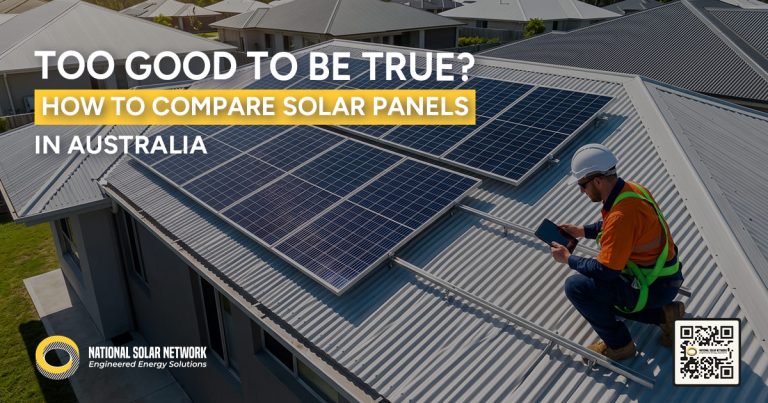
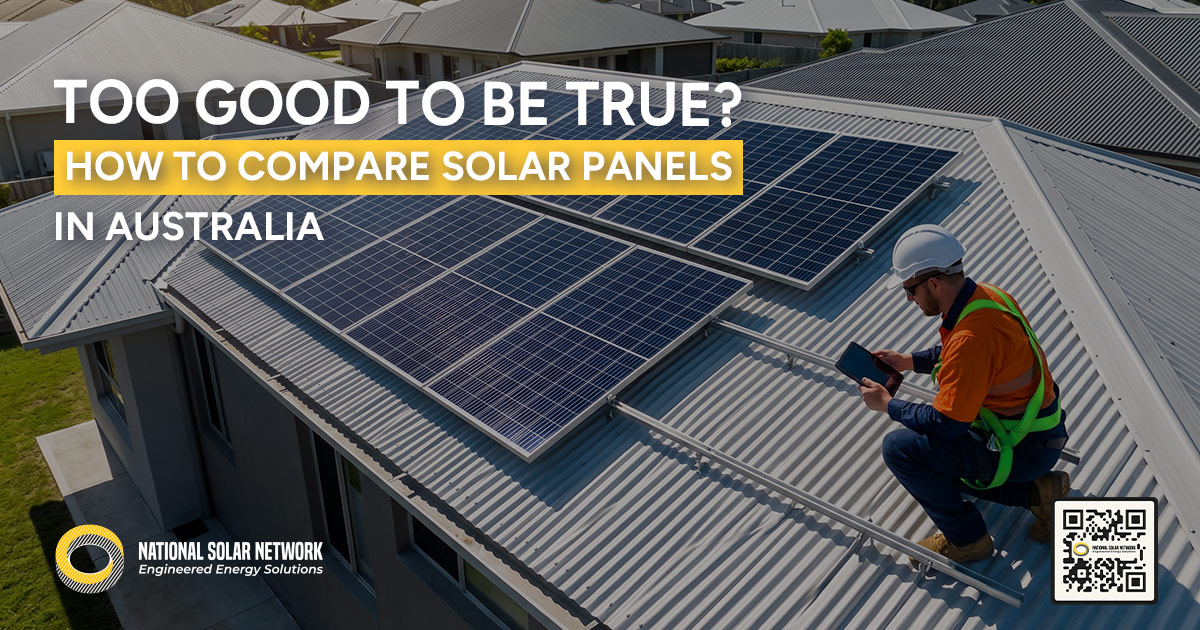
A quote lands in your inbox with a price that undercuts everyone else by thousands. It is tempting to just say yes.
Before you do, it helps to know what that number is actually buying. A headline price on its own tells you very little. The system behind it, the components, and the work included are what you are really paying for. Here is how to sanity-check a solar offer and compare quotes on the same footing, from a Central Queensland point of view.
Why some solar offers look too good to be true
A cheap price is not automatically a scam. But it is almost always paid for somewhere.
When one quote sits far below the rest, the saving usually comes from one of three places: cheaper components than the competing quotes, a smaller system than you actually need, or work quietly left out of the scope. None of that is visible in the headline figure.
That is the whole problem. The number that looks like the best deal is the one number that cannot tell you whether it is.
The traps hiding behind a cheap price
Most too-good-to-be-true offers share the same handful of shortcuts. Knowing them turns a vague “this feels off” into specific questions:
- A budget inverter. The inverter is the hardest-working part of the system. A cheap one on premium panels drags down the whole result and often fails first.
- An undersized system. A smaller kW size looks cheaper today but leaves you short on the power you actually use.
- Work left out of scope. Switchboard upgrades, meter changes, or extra cabling get excluded, then reappear as variations after you have signed.
- Vague component specs. “Tier 1 panels” with no brand or model named is not a specification. It is a placeholder.
- Thin or subcontracted installation. A low price sometimes means the cheapest available crew, not the accredited team you assumed.
- Weak warranty terms. A big warranty number means little if it is a product warranty of a few years dressed up as long-term cover.
Compare solar quotes like-for-like
Two quotes cannot be compared until they describe the same thing. Different system sizes, different components, or different scopes make a price comparison meaningless.
To compare solar quotes properly, line them up against a complete-quote checklist and see which ones actually fill it in:
| A complete quote spells out | Why it matters |
| System size in kW and panel count | The starting point for every other comparison |
| Panel brand and exact model | “Tier 1” alone is not a spec |
| Inverter brand and exact model | Where cheap offers cut corners most |
| Product, performance and inverter warranties | Separates real cover from headline numbers |
| Full scope of work | Switchboard, meter, cabling, mounting all listed |
| Who carries out the install | Accredited installer, not an unnamed subcontractor |
| Price after rebates, itemised | Shows what the discount actually is |
| Aftercare and support | What happens if something fails later |
If a quote leaves boxes blank, that is your answer about what it is hiding.
What to compare on the panels themselves
Once the quotes are on equal footing, the panels are worth a closer look. A few criteria separate a genuine deal from a cheap one:
- Product vs performance warranty. The product warranty covers the panel against faults, the performance warranty covers output over time. You want both stated, and a long product warranty matters most.
- Efficiency. Higher efficiency earns its keep when roof space is tight, less so on a large clear roof.
- Temperature coefficient. In Queensland heat, a panel that loses less output as it warms is worth having.
- Track record over badges. A brand with a real Australian support presence beats a Tier 1 label with no local backing.
- Cost per watt. Dividing price by total watts gives you the true price signal, and a fairer way to compare solar panels australia wide than a headline total.
Rebate and “free solar” claims to check
Rebate language is where offers get slippery. The federal solar incentive comes as small-scale technology certificates (STCs), which lower the upfront price. They are a discount, not free money, and their value changes over time.
Treat these as warning signs: “free solar,” “instant rebate,” or a promise that you definitely qualify before anyone has seen your property. Rebate eligibility depends on your system and on the install being done by SAA-accredited installers. Any offer that guarantees an outcome before an assessment is selling certainty it does not have.
Questions to ask before you sign
You do not need to be technical to pressure-test an offer. A short list forces the important details into the open:
- Which exact panel and inverter brand and model am I getting?
- Who physically installs it, and are they SAA-accredited?
- What is excluded from this price, and what could become a variation?
- What are the product, performance and workmanship warranties, in years?
- What happens, and who do I call, if something fails in year three?
- What is the price after STCs, itemised?
An honest quote answers all six without hesitation. Hesitation is the signal.
Comparing offers the right way in Rockhampton
The best defence against a too-good-to-be-true offer is a clear one to compare it against. When a quote itemises the system, names every component, and spells out the scope, you finally have a real basis to weigh other offers on.
That is how we quote. A site assessment, an itemised proposal, and solar panel installation in Rockhampton by SAA-accredited installers, with the Queensland rebates applied properly rather than promised upfront. It gives you a straight benchmark to compare solar plans against, wherever the other quotes came from.
Want a quote you can actually check line by line? Request a free solar assessment and compare it against anything else on your table.